

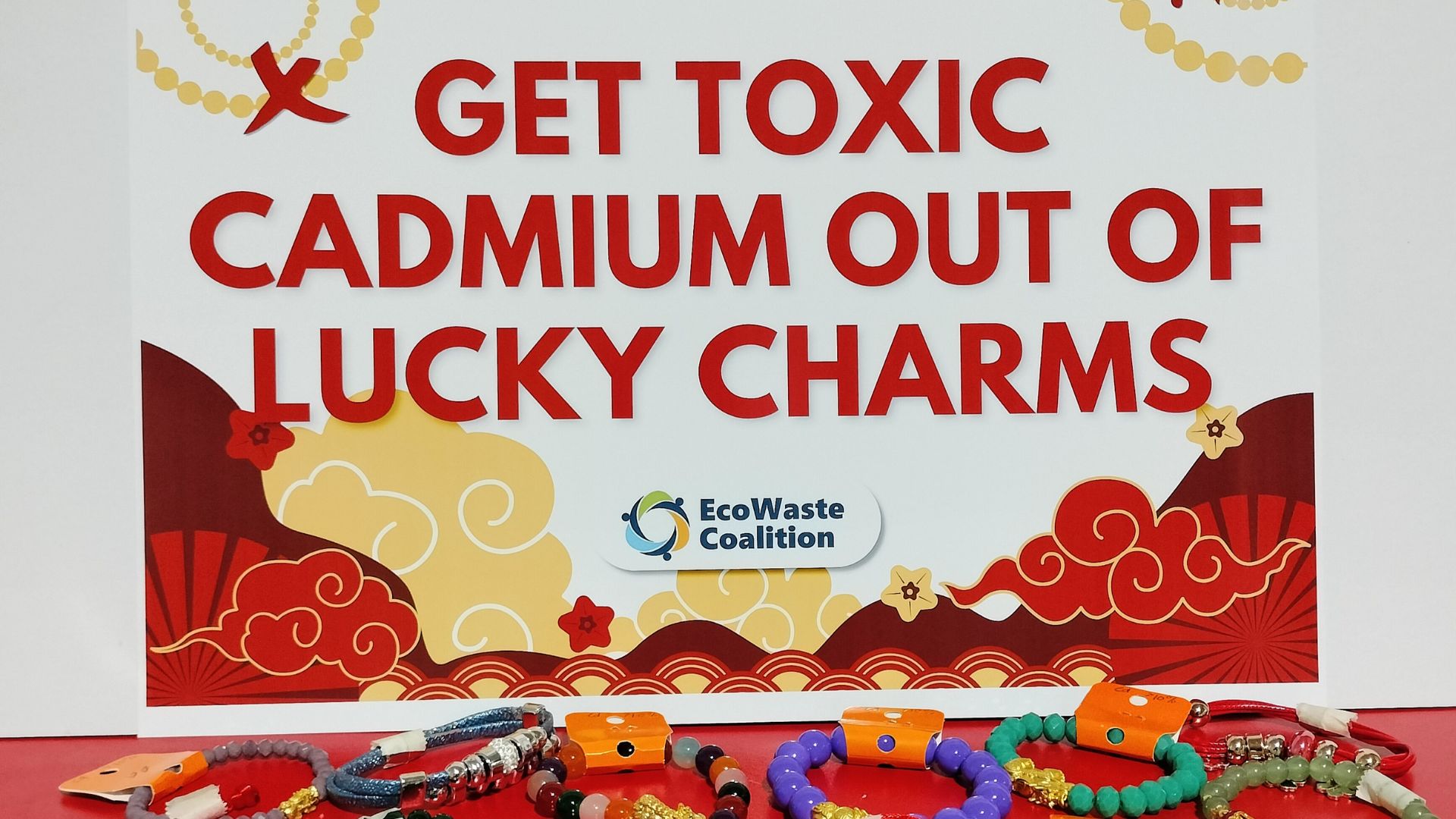






As the sale of luck activators thrives ahead of the Chinese New Year, the EcoWaste Coalition, an advocacy group for a zero waste and toxics-free society, expressed concern over the proliferation of lucky charm bracelets with high-cadmium Pi Yao (aka Pi Xiu) and other auspicious symbols.

Cadmium, with atomic number 48 and symbol Cd, is among the 10 chemicals or groups of chemicals of major public health concern as determined by the World Health Organization (WHO), warning “cadmium exerts toxic effects on the kidneys as well as the skeletal and respiratory systems (and) is classified as a human carcinogen.”

While cadmium in jewelry is restricted in the European Union (EU) to not more than 0.01 percent (or 100 parts per million or ppm) by weight of metal beads and other metal components, the EcoWaste Coalition found mind-blowing levels of cadmium in lucky charm bracelets sold locally, particularly those adorned with golden Pi Yao, a mythical symbol said to bring good fortune, wealth, and protection.
As part of the group’s observance of the Zero Waste Month this January, the EcoWaste Coalition analyzed some lucky charm bracelets with golden Pi Yao purchased from retailers in Quiapo, Manila, for P35 to P95 each.
Out of 25 beaded and red string bracelets procured, 18 were found to contain Pi Yao components with extremely high cadmium content in excess of 10 percent (or over 100,000 ppm), as measured by the group using a handheld X-ray fluorescence (XRF) spectrometer. In jewelry making, some manufacturers still use cadmium to add mass and weight to the item and make a lustrous finish.

The golden Pi Yao in the remaining seven items screened negative for cadmium content, a concrete proof that cadmium use in jewelry making can be eliminated, the EcoWaste Coalition said, noting that the WHO has recommended the “elimination of use of cadmium in products such as toys, jewelry, and plastics” as one of the interventions to reduce cadmium releases and occupational and environmental exposure.
According to the group, none of the 25 lucky bracelets were properly labeled, and none of the high-cadmium items provided any cadmium content information or precautionary warnings, keeping consumers in the dark about potential cadmium exposure risks, especially for children.
As explained by the Department of Health of New York State: “The greatest potential for exposure comes from swallowing a jewelry piece. However, exposure also occurs from repeated biting, sucking, or mouthing the jewelry piece or from frequent hand-to-mouth contact after handling a jewelry piece. These behaviors are common in children younger than six. The amount of exposure depends on how much cadmium is in the piece of jewelry and how often and for how long a child bites, sucks, or mouths it.”
As ordinary consumers would not be able to differentiate lucky charm bracelets with a non-cadmium Pi Yao from those with a high-cadmium Pi Yao, the EcoWaste Coalition emphasized the importance of ensuring that such products are duly regulated, tested prior to sale, certified, and labeled cadmium-safe.
In line with the consumers’ right to know, the EcoWaste Coalition urged jewelry manufacturers, distributors, and sellers to label and disclose the chemical composition of their products, including the hazards they pose, if any, to humans and the environment.
The group likewise urged the government to review regulatory standards and fix the apparent gaps that have allowed high-cadmium jewelry articles and fashion accessories to flourish in the domestic market. It also urged the authorities to conduct essential information, education, and communication activities to promote business and industry compliance and ensure that the consumer interest is firmly protected.
The above actions, the EcoWaste Coalition said, will help advance the aim of the Global Framework on Chemicals—For a Planet Free of Harm from Chemicals and Waste, which is “to prevent or, where prevention is not feasible, minimize harm from chemicals and waste to protect the environment and human health, including that of vulnerable groups and workers.”

